


In short
- Law firm handling road accident compensation, promoted through Google Ads Search, with a comparable monthly budget throughout.
- A four-step method: discovery with a single Broad keyword, selection down to 8 keywords and 784 exclusions, a page in the victim's vocabulary, new ads.
- The "no upfront cost" message mattered: RON 101 per conversion on the new ad, versus RON 170 on the old one.
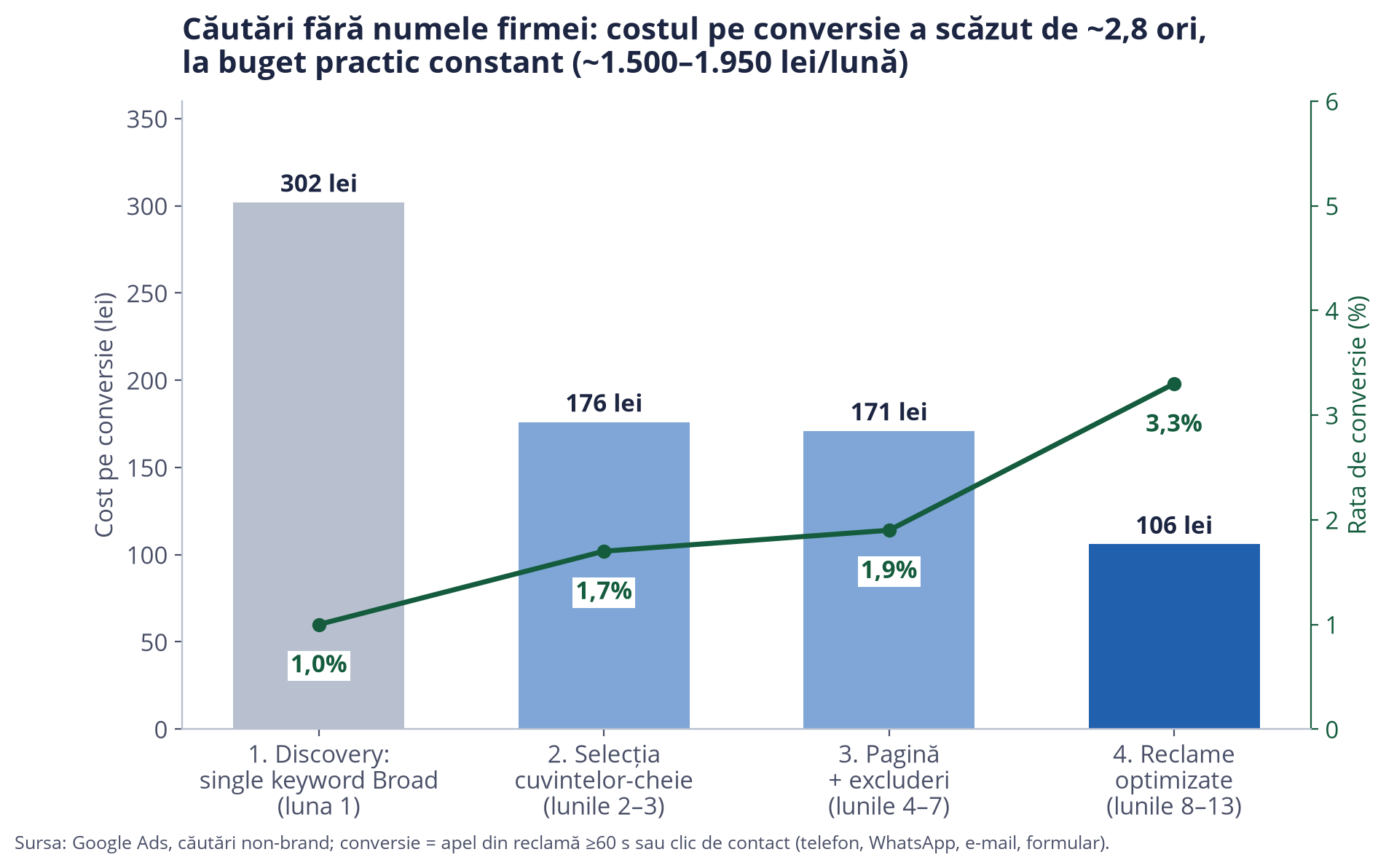
- Cost per conversion fell 65%, from RON 302 to RON 106, and the conversion rate rose from 1.0% to 3.3%.
The context: an accident victim isn't searching for "a lawyer"
Compensation for road accident victims is one of the most contested legal niches on Google Ads. Competition is fierce, clicks are expensive, and a big share of traffic comes from people who'll never become clients: other lawyers, drivers settling claims directly with their insurer, and people reading accident news.
What's specific about this niche:
- the person seeking help has just been through a traumatic event – themselves or someone close;
- they don't describe the service ("lawyer") but their situation: days of medical care, non-material damages, personal injury;
- the question of upfront cost can matter as much as whether the case is eligible – something we would later identify and test in the ads;
- the decision to call is made quickly, on the phone, if the ad and page answer exactly their question.
From there, we built the campaign on a four-step method, each step with a clear role: discovery, selection, page, ads.
Step 1: discovery with a single Broad keyword
Instead of guessing dozens of keywords upfront, we started from research built around "accident victims and their families" and launched a single broad-match keyword (Broad), on the niche's core intent. Its job in month one wasn't to be profitable but to act as a probe: to show us, from real searches, how people who need this service actually talk.
The search terms triggered by this keyword produced two lists:
- the useful terms – the phrasings that brought enquiries: "compensation", "non-material damages", "days of medical care", "personal injury";
- the terms to exclude – all the traffic eating budget with no chance of becoming a client.
In parallel, we ran two control campaigns on phrase and exact match, built from the initial research. The result confirmed the approach: relevant searches were far more varied than any desk-written list, and a well-supervised Broad caught them all.
The discovery month, on searches without the firm's name: RON 302 per conversion, at a conversion rate of 1,0%. That was the starting point.
Step 2: keyword selection and the 784 exclusions
The second stage was about cutting. Of the keywords tested we kept 38, then narrowed them step by step to 8 – only those actually bringing enquiries. The rest were paused and budget focused on intents that convert.
At the same time, we built the exclusion list. By the end, the account had 784 negative keywords, all exact match – a precise map of who isn't a client:
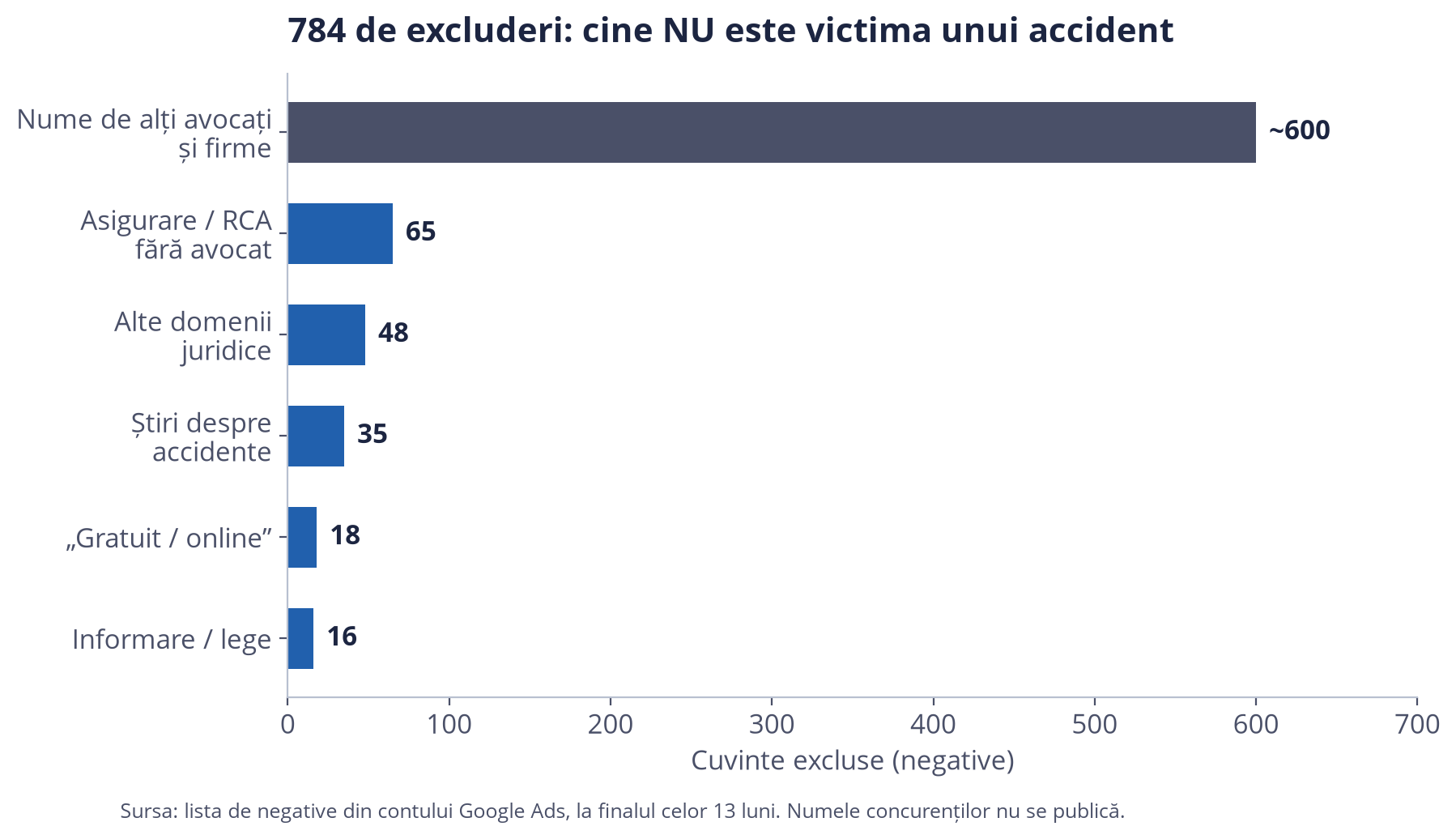
- ~600 – names of other lawyers and law firms;
- 65 – insurance and motor-insurance searches without a lawyer (people settling the claim themselves);
- 48 – other areas of law (workplace accidents, drink-driving);
- 35 – accident news ("accident today", "motorway accident");
- 18 – "free" or "online" searches;
- 16 – information about the law and procedures.
Exclusions were added continuously as new terms appeared. In this project, the Broad keyword was useful as a discovery tool precisely because we kept controlling the actual search terms and exclusions. It wasn't broad match itself that produced the result, but the subsequent selection of relevant intents.
After selection, cost per conversion dropped to RON 176, and the conversion rate rose to 1,7%.
Step 3: the page, aligned with the victim's vocabulary
A well-chosen search and a good ad aren't enough if the page speaks a different language. The compensation page was aligned with the same words the victim uses and checked across every contact route: phone, WhatsApp, email and form. Someone searching "non-material damages after an accident" needs to find exactly the answer to their question on the page, and an easy way to call.
At this stage, with exclusions built up and the page aligned, cost per conversion settled at RON 171, with a conversion rate of 1,9% – and fewer wasted clicks.
At this point, the page had been optimised for search language and access to contact, but the "no upfront cost" argument wasn't yet on the page or in the ads. The next stage shows why data analysis can't replace asking the client about their real offer.
Step 4: the ad that talks about cost
Campaign data showed us what people search for, but couldn't on its own explain every question stopping them from contacting the lawyer. We kept talking with the client to understand how the service actually works and what important information wasn't yet in the online messaging. That's how we found a commercial argument worth bringing to the fore: the option of getting legal help with no upfront cost. The original ad listed case types – personal injury, pedestrians, fatalities. The new version explicitly added this argument:
- "Compensation lawyer";
- "Legal help with no upfront cost".
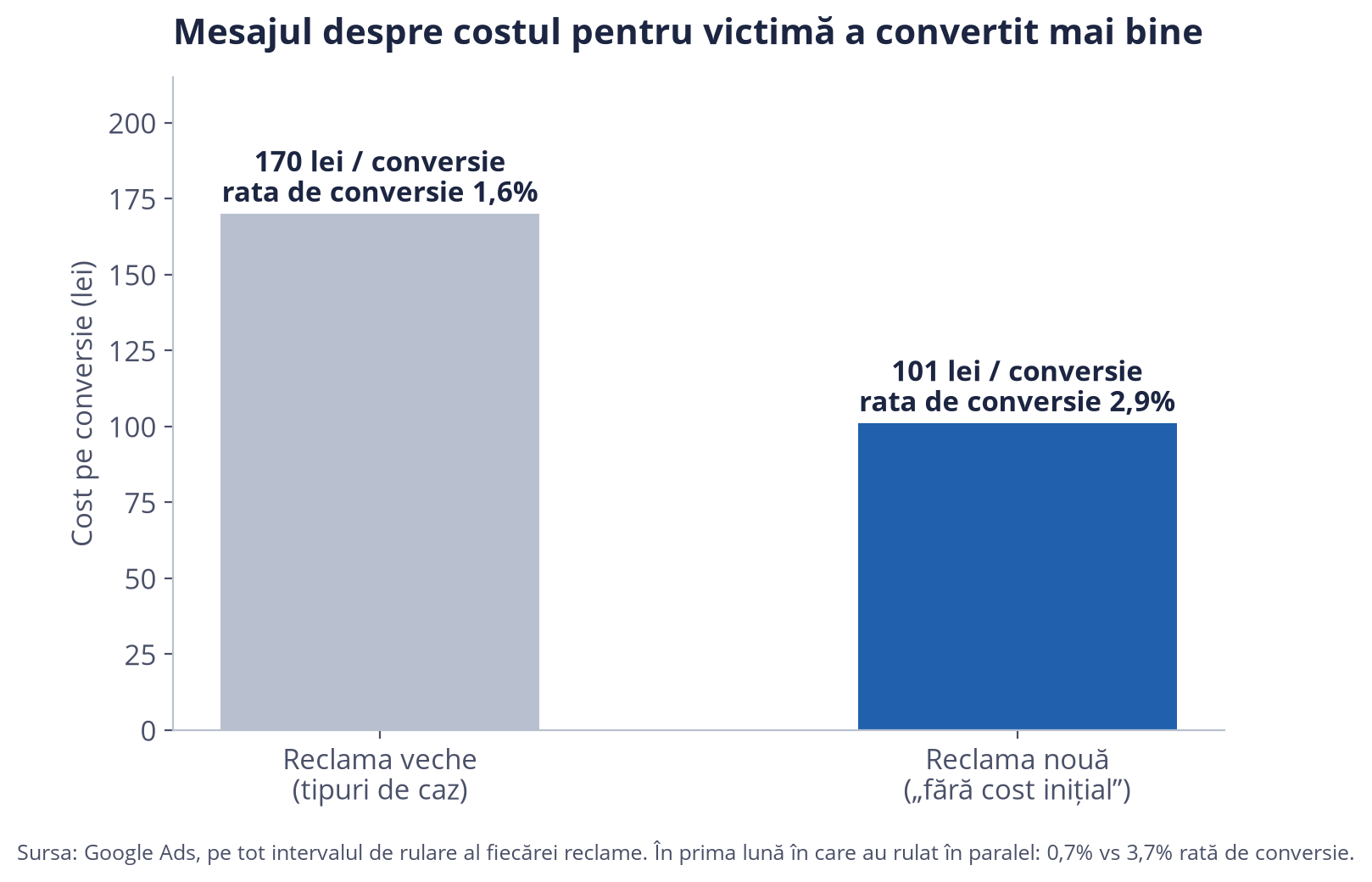
The difference showed immediately. In the first month the two ads ran side by side, the conversion rate was 0.7% for the old ad and 3.7% for the new one. Over the full run:
The ad comparison gives a measurable signal about the message's effectiveness, but the whole campaign's progress also reflects earlier cumulative optimisations: keywords, exclusions and the page.
- old ad: RON 170 per conversion, conversion rate 1.6%;
- new ad: RON 101 per conversion, conversion rate 2.9%.
The results: ~2.8x cheaper, on the same budget
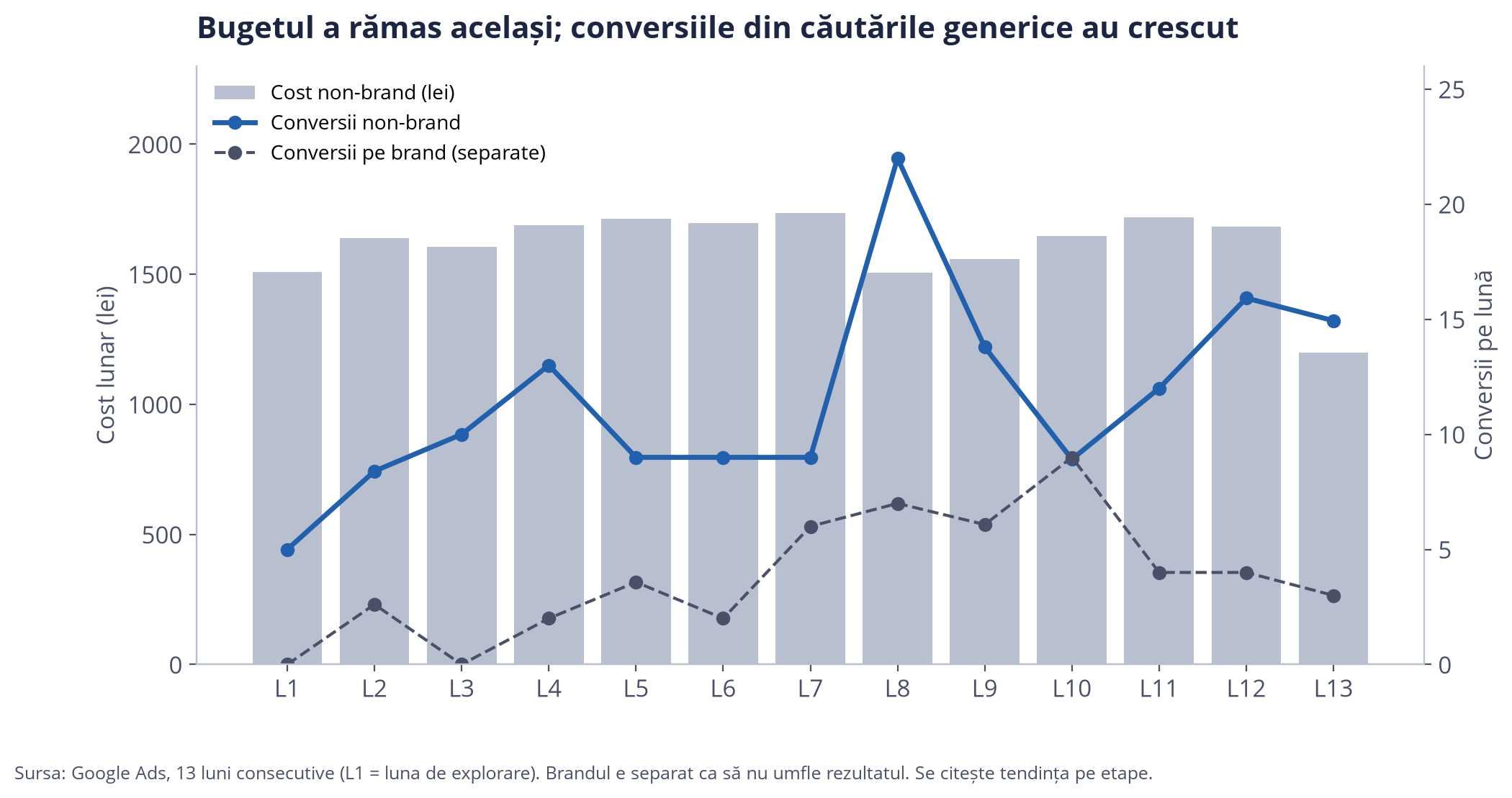
To measure the method's progress as fairly as possible, we separated searches for the firm's name. These grew over time too, but we left them out so we wouldn't credit the client's reputation to generic search optimisation. All figures below are generic searches only, with a comparable monthly budget of roughly RON 1,500–1,950. The main comparison is between month 1 and months 8–13; the stages have different lengths, and the "Conversions" column shows the volume recorded in each period, not a like-for-like monthly average.
| Step | Period | Conversions | Conversion rate | Cost per conversion |
|---|---|---|---|---|
| 1. Discovery (single Broad keyword) | month 1 | 5,0 | 1,0% | RON 302 |
| 2. Keyword selection | months 2–3 | 18,4 | 1,7% | RON 176 |
| 3. Page + exclusions | months 4–7 | 40,0 | 1,9% | RON 171 |
| 4. Optimised ads | months 8–13 | 87,5 | 3,3% | RON 106 |
- Cost per conversion: −65%, from RON 302 to RON 106 – about 2.8x lower.
- Conversion rate: 3.3x higher, from 1.0% to 3.3%.
- Budget: the same order of magnitude. Performance improved without any substantial increase in monthly spend, through search selection, the landing page and messaging.
- Across the whole account, including searches for the firm's name, cost per conversion fell from RON 305 to RON 93.
The method is the same one we apply in marketing for lawyers and law firms: intent comes before volume, and every unit of budget has to reach someone who really needs the service.
What we learned about who looks for help
Beyond the results, the campaign revealed a profile of the person who calls that's different from what a generalist would assume:
- vocabulary: "compensation", "non-material damages X days of care", "personal injury" – not "lawyer";
- who calls: women accounted for 29% of spend and 50% of conversions;
- where from: about 60% of conversions came from a single historical region of the country, not the capital;
- the message that worked: the "no upfront cost" wording outperformed simply listing case types; this is an observation from ad testing, not a direct measure of what motivates everyone seeking help.
Conclusion
In legal niches, the number of keywords says nothing about a campaign's quality. A single Broad keyword used as a discovery tool, followed by strict selection, a page that speaks the client's language and an ad that answers their real hesitation, cut cost per enquiry almost threefold, without adding anything to the budget.
The difference didn't come from more traffic, but from better understanding the intent behind the search. An agency can't only optimise what it sees in Google Ads or what's already on the website: it has to ask the right questions, stay in touch with the client and turn the commercial insights it uncovers into messages it can then test in the data.



 © 2026 Digital Craft® Agency - All rights reserved.