


In short
- Grant funding consultancy, promoted through Google Ads Performance Max during a national programme's window.
- Tracking first, then budget: the gap between Google Ads and GA4 was fixed before spend went up.
- Budget rose ~3.9x in the peak phase, while cost per form rose only ~13.5% (from RON 9.6 to RON 10.9).
- 2,381 forms in 7 weeks, with a sweet spot of RON 8.5 per form at RON 300–600 a day.
The context: huge demand that lasts a few weeks
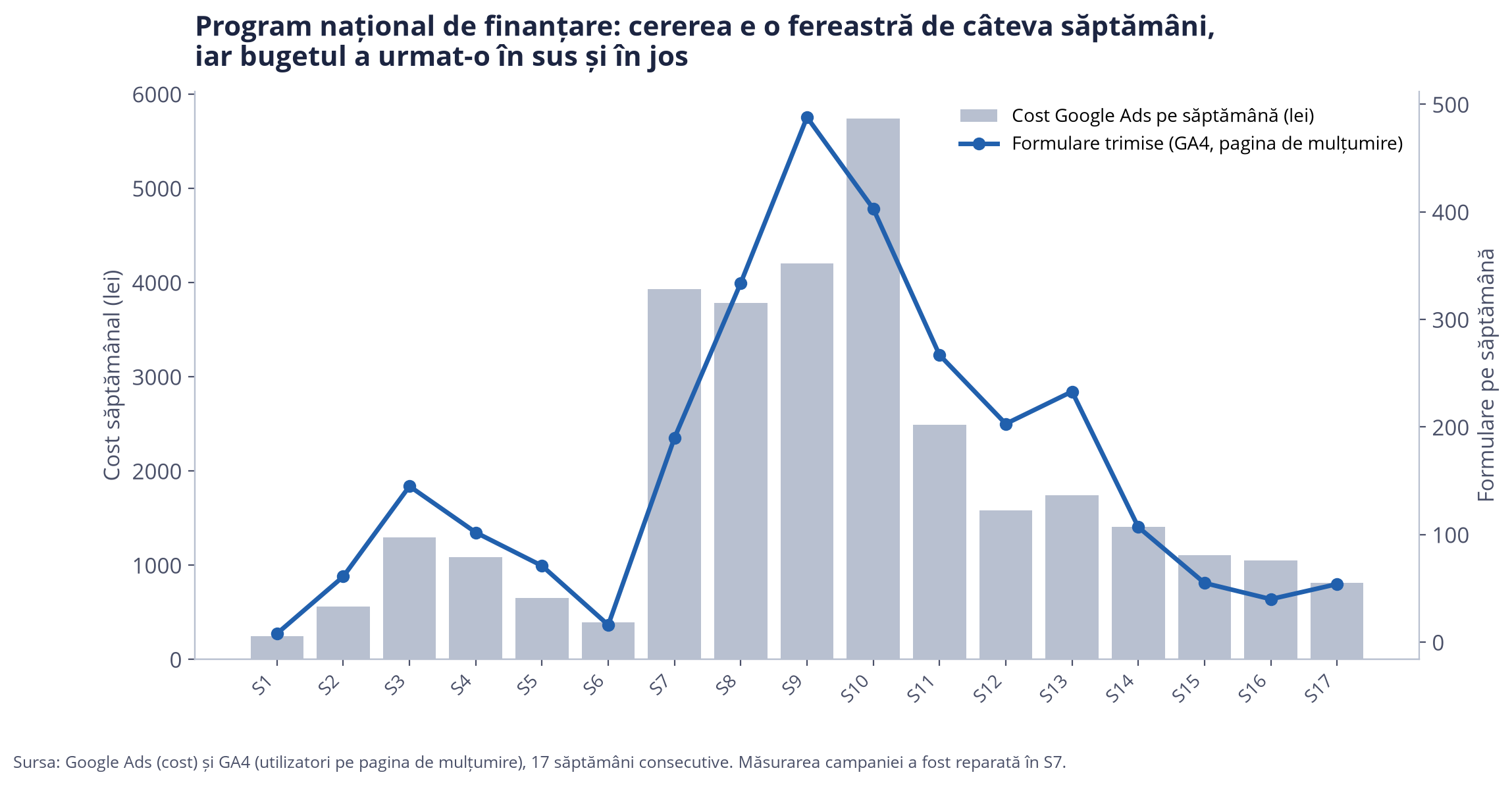
National funding programmes for new businesses have a demand pattern very different from many financial services. Before the official launch, interest may show up in only a handful of searches, and the programme announcement, amplified by press, TV and other media, can quickly turn the market into a wave of searches for consultancy. There's no steady flow of clients all year, but a short window in which many entrepreneurs are all looking for someone to prepare their application.
What's specific about this kind of demand:
- volume can climb steeply right after the launch announcement and around the opening of applications, then drop within a short period;
- the searcher already has the business they want to fund in mind – garage, café, clinic, solar panels;
- decisions are made quickly, on the phone;
- once the window closes, the same search is worth several times less.
For a funding consultancy, that raises a marketing question: can you build a Google Ads campaign able to absorb a much bigger budget quickly when demand suddenly appears, and scale back when interest drops? This project's answer was yes – and the study shows how.
Time-bound campaigns aren't reserved for social ads. Google Ads usually has more inertia and needs signals and structure to optimise, but it can be prepared ahead of a short demand spike. The advantage wasn't launching when the news wave began, but already being there when searches took off.
Before the money: tracking
The first decision was not to raise the budget until we had a conversion signal we could use for optimisation. In the first weeks, Google Ads and GA4 reporting showed a very large gap for the period analysed:
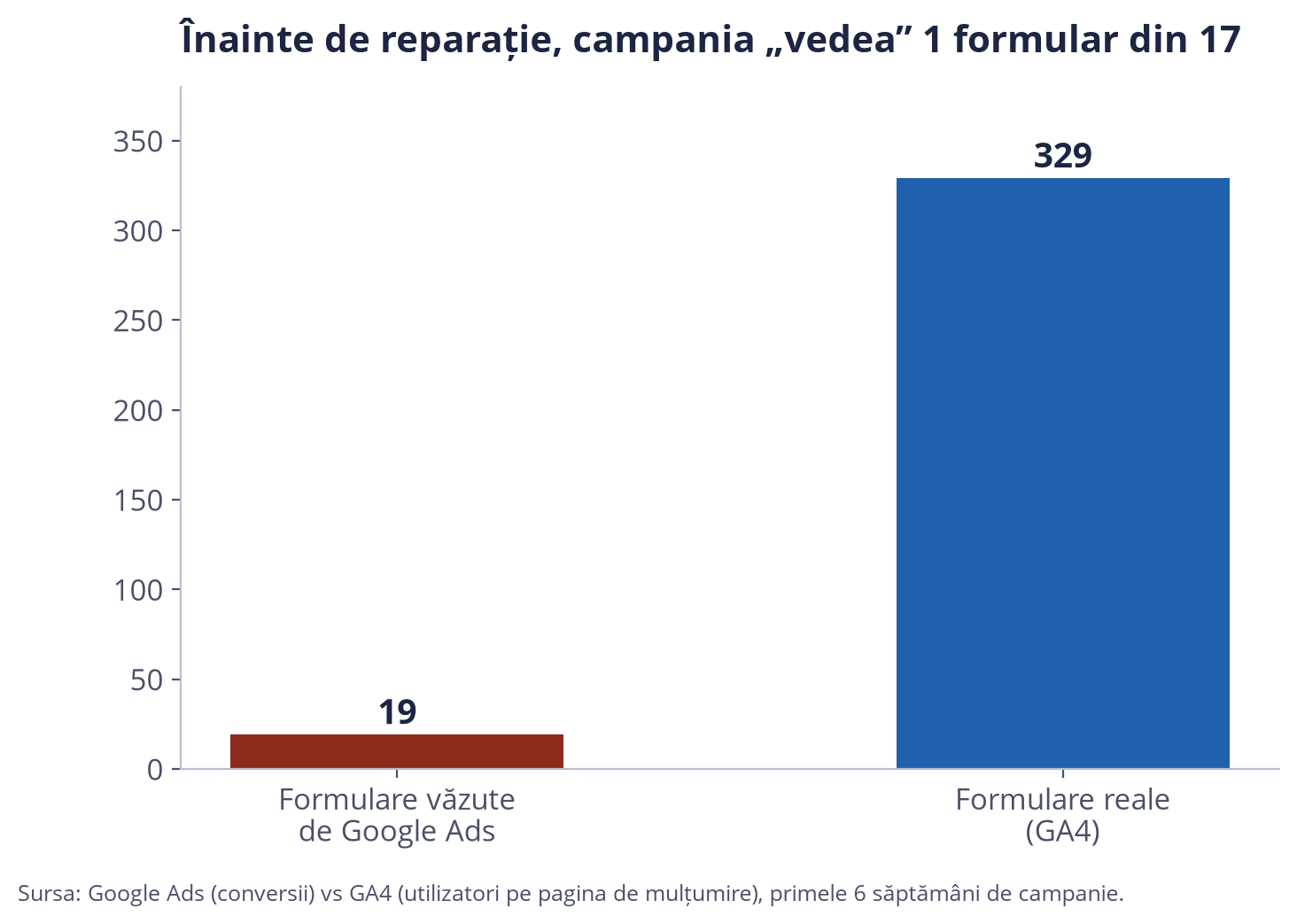
- 19 forms reported by Google Ads;
- 329 form submissions recorded in Google Analytics 4 on the site – about 17 times the Google Ads figure.
We moved tracking to the programme's new thank-you page and imported the event as the primary conversion goal. That gave Performance Max a better-defined optimisation signal. We set up tracking and structure before demand surged, not mid-wave, when every lost day could mean missed enquiries.
A structure that can absorb a big budget
A wave campaign needs a simple structure ready before demand rises, to avoid rebuilding campaigns just as searches arrive. It doesn't mean skipping the learning period, but cutting down major changes made under pressure:
- two Performance Max campaigns, each with a single asset group, pointing to the same programme page;
- the first, on programme intent: search themes about funding for new businesses, grants, startups;
- the second, on business types: 31 themes – car repair, car wash, café, artisan bakery, clinic, solar panels, PVC joinery, drones and more;
- the whole country, with no regional adjustments – the programme is national and demand comes from everywhere;
- Maximise Conversions bidding, with no target CPA – so the algorithm could scale volume fast;
- mobile first: 93% of spend and 95% of conversions came from phones, so the page and form were designed for mobile.
Budget in stages: launch, ramp-up, peak, cut, tail
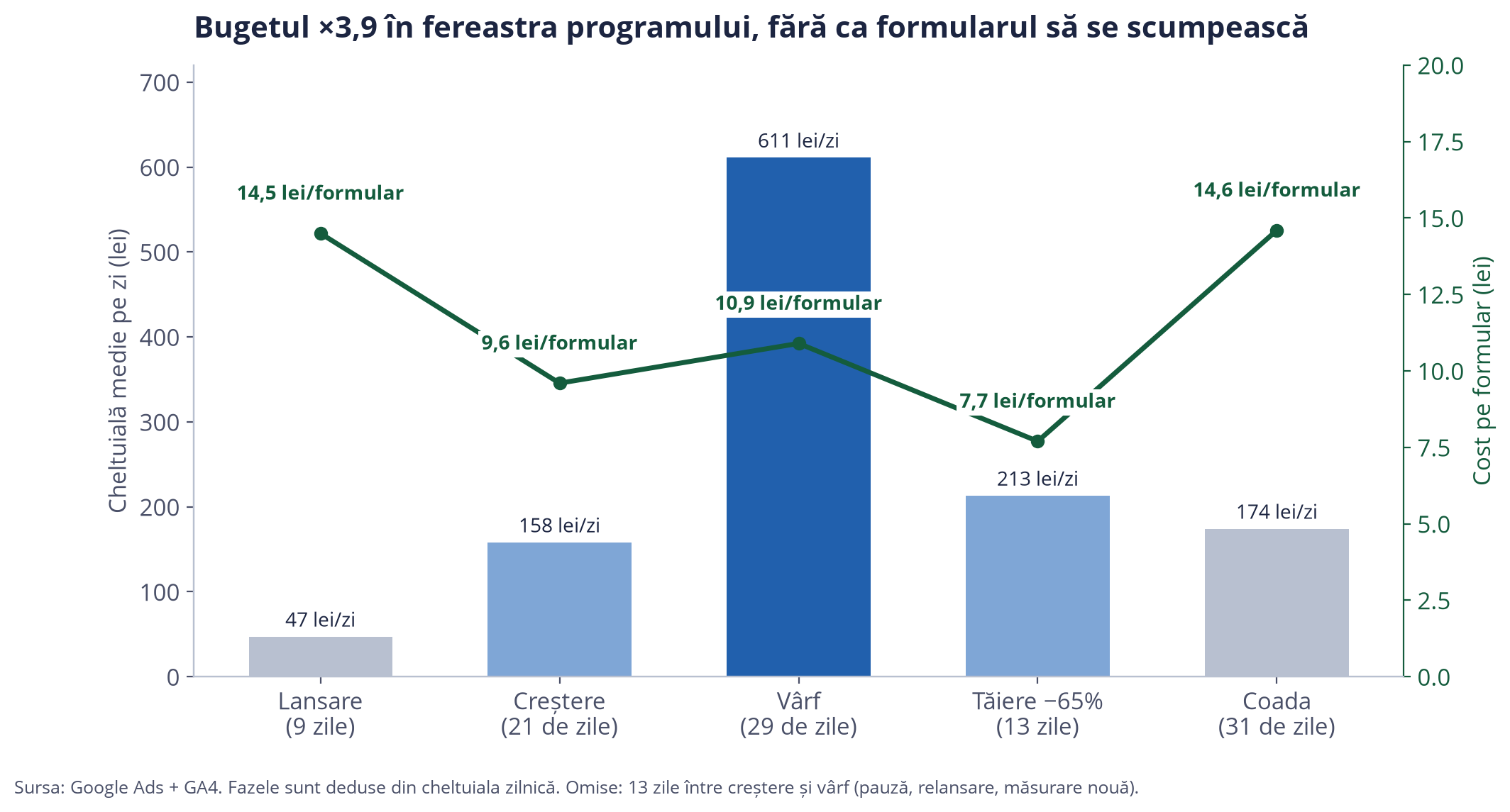
The budget wasn't a fixed monthly cap but a lever adjusted day by day according to demand. When the public announcement and media coverage sped up searches, the campaigns were already live and ready to capture existing intent. By phase:
| Phase | Duration | Spend/day | Forms/day | Cost per form |
|---|---|---|---|---|
| Launch | 9 days | RON 47 | 3,2 | RON 14.5 |
| Growth | 21 days | RON 158 | 16,5 | RON 9.6 |
| Peak | 29 days | RON 611 | 56,2 | RON 10.9 |
| ~65% cut | 13 days | RON 213 | 27,8 | RON 7.7 |
| Window tail | 31 days | RON 174 | 11,9 | RON 14.6 |
What the data shows:
Interpretation note: the five operational phases shown add up to 103 days; the overall stated period is 17 weeks (119 days). The table describes the phases whose daily averages are shown here, not a breakdown of every day in the full period.
- volume followed budget within 1–2 days – on relaunch, forms climbed to over 60 a day within days;
- budget rose ~3.9x (from RON 158 to RON 611 a day), while cost per form rose much more slowly, from RON 9.6 to RON 10.9 (about +13.5%);
- cutting at the right time made forms cheaper: when demand started to fall, we cut spend by ~65% and the cost dropped to RON 7.7;
- in the window's tail, forms got more expensive even on a small budget – a sign that demand was fading, not that money was short.
Where the sweet spot is: RON 300–600 a day
Over the 73-day sub-period analysed with the same tracking method, we grouped days by spend level. For this campaign, the analysis shows the range where the average cost per form was lowest:
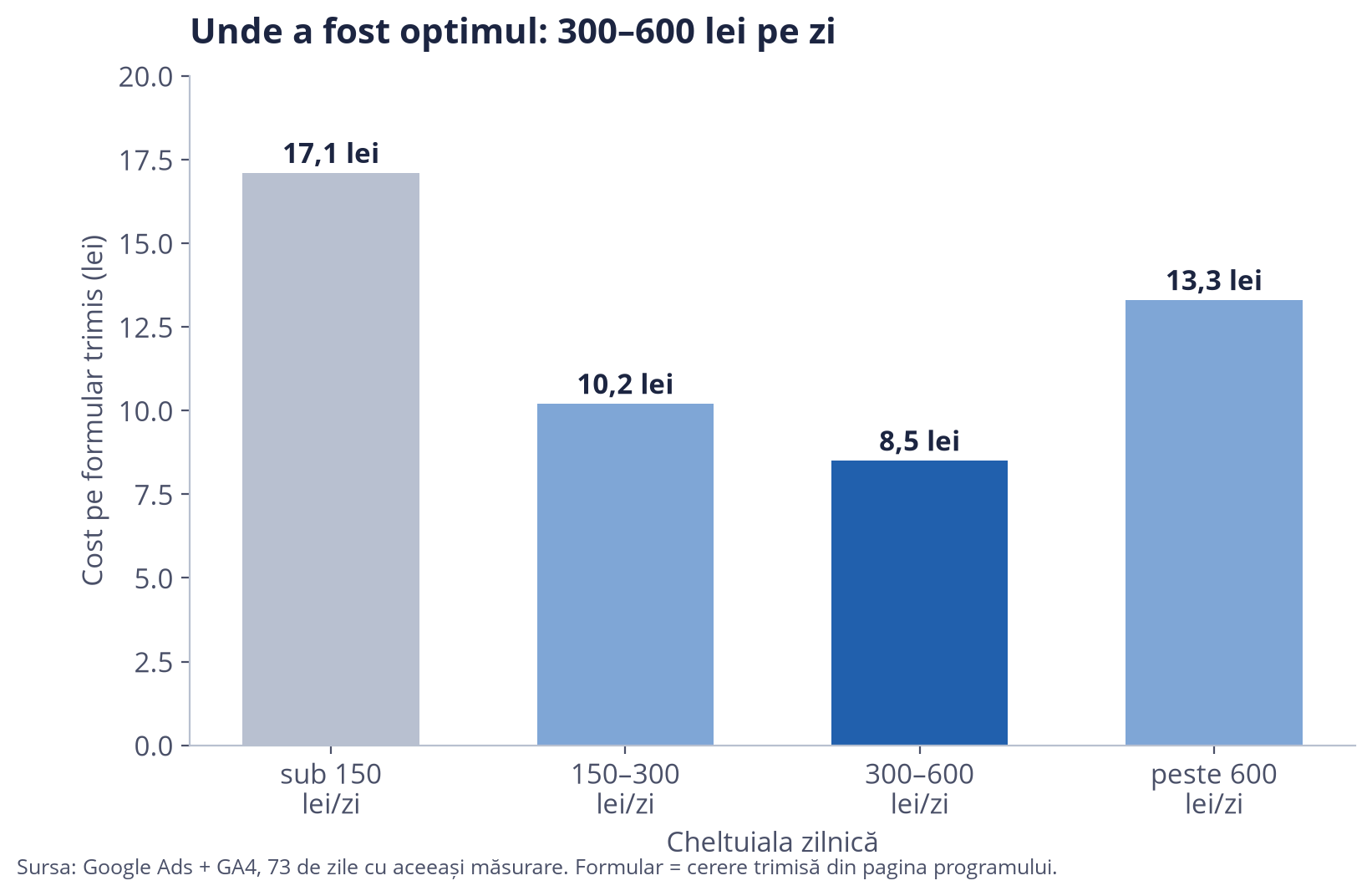
- under RON 150/day: RON 17.1 per form;
- RON 150–300/day: RON 10.2;
- RON 300–600/day: RON 8.5 – the sweet spot;
- over RON 600/day: RON 13.3.
In this set of days, the RON 300–600/day range had the lowest average cost per form. The data describes what worked here, in this demand window; it doesn't set a universal optimal budget for other campaigns or programmes.
The second source of volume: business types
Someone who wants funding isn't just searching for the programme – they're looking for funding for their business. Building on that, during the window we added a second Performance Max campaign with 31 business-type themes. It brought extra volume at a comparable cost: RON 15.3 per conversion, versus RON 16.2 for the programme-intent campaign, over the full period.
The result: high volume, stable cost
- 2,381 forms over the 7-week run shown in this study (234 + 387 + 578 + 470 + 321 + 243 + 148); average costs per form for each budget phase are detailed in the table above;
- a peak of 578 forms in a single week;
- budget ×3.9 in the peak phase versus the ramp-up phase, with cost per form up only ~13.5% (RON 9.6 → 10.9);
- a sweet spot of RON 8.5 per form at RON 300–600 a day;
- RON 7.7 per form after the timely cut.
We apply the same way of working – accurate tracking, simple structure, demand-led budget – in financial services marketing, where the timing of demand matters as much as the message.
What we learned about funding demand
- Demand is a window, not a stream: across the whole campaign, 76% of forms fell within roughly 8 weeks. Outside the window, a general "all programmes" search campaign cost ~RON 59.6 per conversion – over five times the RON 10.9 per form in the peak phase shown in the table. These are different campaigns and periods, used here as cost benchmarks under different demand conditions.
- The weekly rhythm is steep: 234 → 387 → 578 → 470 → 321 → 243 → 148 forms per week around the peak.
- Mobile decides: 95% of conversions came from phones.
- The campaign has to be ready beforehand: tracking, structure, the page and the ability to scale budget are prepared before official announcements and their media echo speed up searches. The news wave isn't the moment to build everything from scratch.
Conclusion
A few-week "boost" isn't reserved for social ad platforms. Google Ads generally has more inertia: structure, conversions and optimisation mechanisms need preparation. But that's exactly why, for wave-type demand – funding programmes, legal deadlines, short seasons – preparation before launch matters more than reaction after it. In this project, interest took off with the public announcement and its media coverage, and we were already there with campaigns and tracking ready.
The budget became a daily lever: from RON 158 to RON 611/day in the phases compared, while cost per form moved from RON 9.6 to RON 10.9. Google Ads can also work as a tool for capturing momentary demand — not by rushing to launch on peak day, but through anticipation, tracking and quickly matching spend to real interest.







 © 2026 Digital Craft® Agency - All rights reserved.