


In short
- Policy checks are the largest micro-niche and the least contested: ~161,000 searches a month, with a competition index of 10/100.
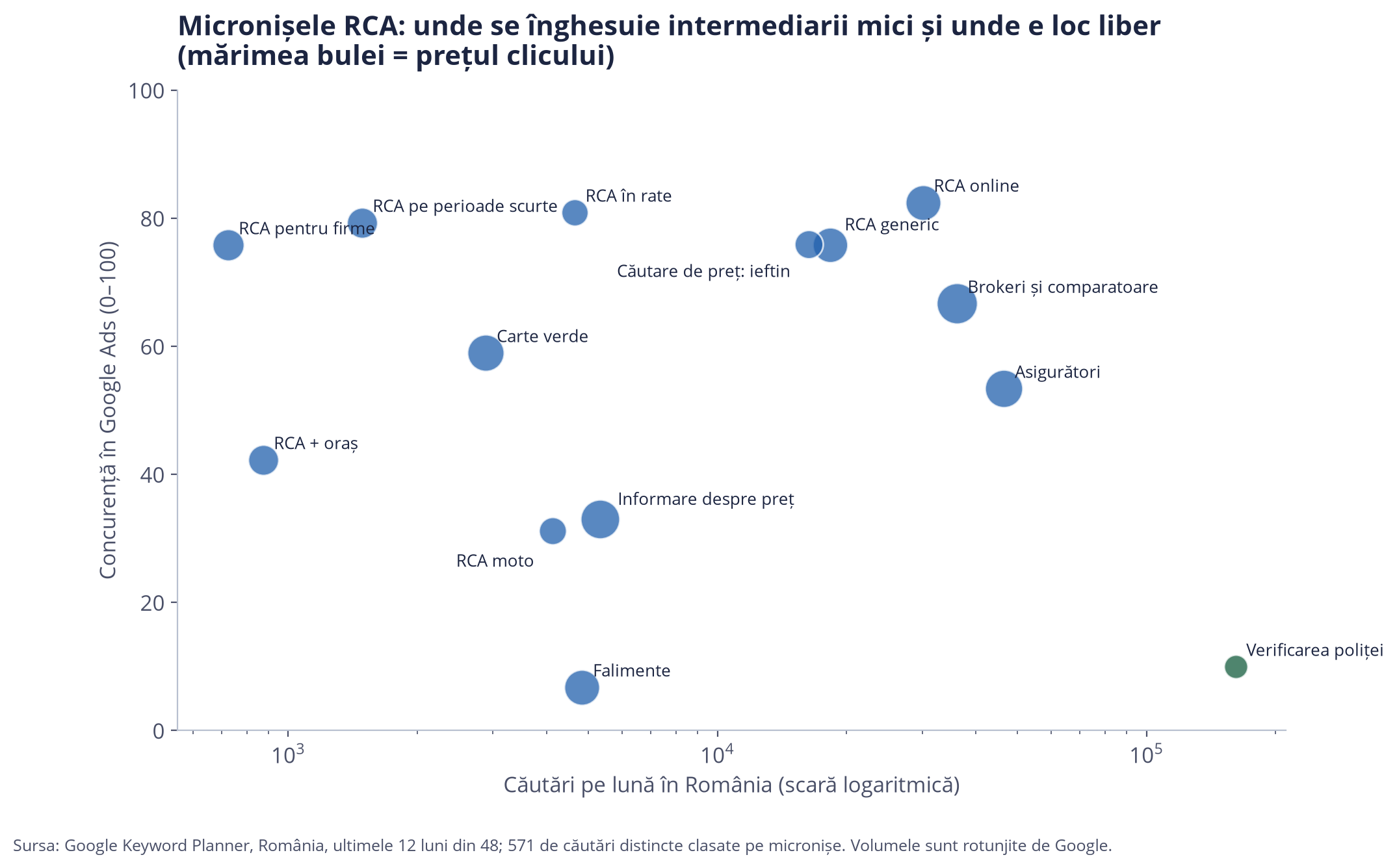
- Intermediaries crowd in on online RCA, instalments, short terms and price searches: competition of 76–83 out of 100 and clicks costing RON 5–9.
- Demand reacts to renewal at the new price, not to the price-rise announcement: +44% for generic RCA, versus +14% seasonal.
- Over four years, demand shifted towards online and brands (online RCA +35%), while generic terms fell (−21%).
Why RCA
RCA is a unique product in the insurance market: compulsory, bought almost entirely on price, renewed every year and sold through hundreds of small intermediaries – local brokers, agents, online platforms, comparison sites. For an intermediary, Google is often the main sales channel, and the difference between a profitable campaign and a loss-making one lies in understanding what people search for, when and why.
We wanted to answer three questions, based on estimated search demand, not campaign sales or conversions:
- which micro-niches small intermediaries compete in, and where there's open space;
- how searches react to price rises, insurer failures and rule changes;
- where demand has moved over the last four years.
Methodology
- Source: monthly volumes from Google Keyword Planner, over the longest history Google offers – 48 months.
- Terms: all RCA and motor insurance searches in our research database for the finance and insurance niche (over 25,000 terms with real volume), plus seed terms for each micro-niche – 692 requested, 571 distinct searches after removing identical variants.
- Classification: 16 micro-niches, using word rules applied in a fixed order. Of these, 12 are purchase and verification micro-niches, 2 are informational (insurer failures/guarantee fund and price/bonus-malus information), and 2 are context categories (generic car insurance and comprehensive cover).
- The seasonal benchmark: for each type of shock, we compared the months after with the months before, then the same transition in the previous year. That separates the reaction to the event from the year's usual variation.
- Precision: Keyword Planner volumes are rounded, banded estimates, so read the figures as order of magnitude and direction; the 0–100 competition index describes relative advertising pressure, not the number of companies bidding, and the estimated cost isn't the actual CPC achieved in campaigns.
The micro-niche map: where intermediaries crowd in
Of the 16 micro-niches, the table shows the 12 categories geared to purchase and verification. The other four play a separate role: generic "insurance" (~80,900 searches/month) and comprehensive cover (~2,360) serve as context benchmarks; searches about insurer failure, the guarantee fund and claims settlement (~4,840), and about price, bonus-malus and price rises (~5,320), support the analysis of reactions to events and news. These volumes are estimated averages for the last 12 months.
| Micro-niche | Searches/month | Competition (0–100) | Estimated click |
|---|---|---|---|
| Policy check | ~161.000 | 10 | RON 3.9 |
| Insurer name searches | ~46.500 | 53 | RON 9.8 |
| Brokers and comparison sites | ~36.100 | 67 | RON 11.4 |
| Online RCA | ~30.100 | 82 | RON 8.6 |
| Generic RCA | ~18.300 | 76 | RON 8.4 |
| Price, "cheap", calculator | ~16.300 | 76 | RON 5.5 |
| RCA in instalments | ~4.650 | 81 | RON 4.9 |
| Motorbike, scooter, e-scooter | ~4.100 | 31 | RON 5.2 |
| Green card, abroad | ~2.900 | 59 | RON 9.2 |
| RCA for 1–6 months | ~1.500 | 79 | RON 6.4 |
| RCA + city | ~870 | 42 | RON 6.3 |
| RCA for companies and fleets | ~720 | 76 | RON 6.9 |
What the map shows:
- the crowded micro-niches – online RCA, instalments, short terms, price searches, companies and fleets – have competition of 76–83 out of 100 and clicks of RON 5–9; this is where small intermediaries fight;
- the largest of the 12 micro-niches in the table also has the lowest ad competition in the group: policy checks – about 161,000 searches a month, about 107,000 of them just for "verificare rca", with a competition index of 10/100 and a top-of-page bid estimate of ~RON 3.9; the informational micro-niche on insurer failures has a lower index (7/100) but isn't among the 12 categories shown;
- nobody searches for the local agent: "RCA + city" has under 1,000 searches a month nationwide.
Three types of shock, three different reactions
Over the four years analysed, the RCA market went through several types of events. Each moved demand differently:
A major insurer's collapse
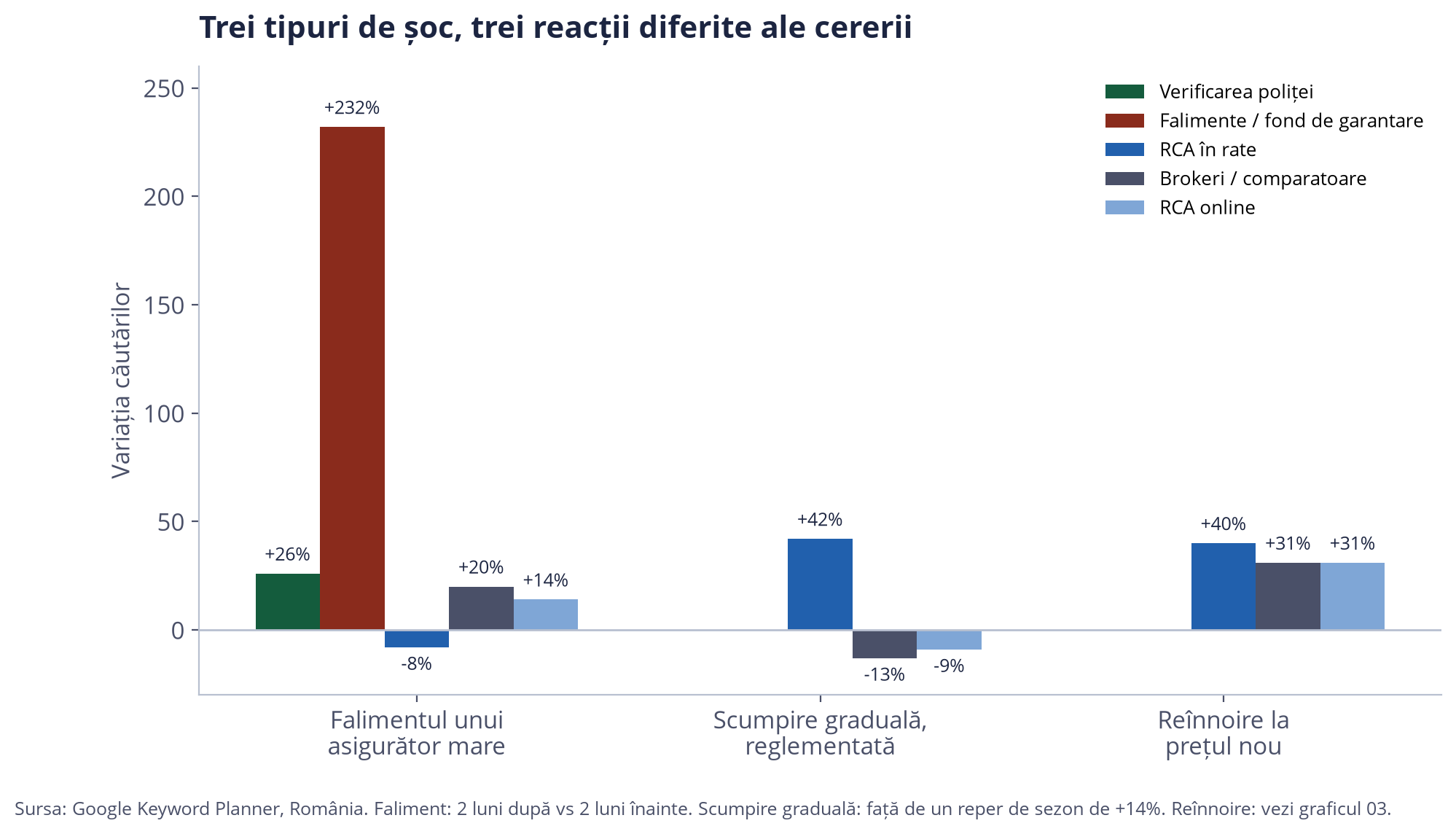
In an episode like this, interest also shifts to safety questions: "is my policy still valid?" and "where do I move it?". Using the comparison applied consistently throughout the study – the average of the two months after the event versus the average of the two months before – searches about insurer failure and the guarantee fund rose by 232%, policy checks by 26%, brokers by 20% and online RCA by 14%, while RCA in instalments fell 8%. In the month of the event, however, policy checks spiked +51% on the previous month (about 130,700 → 197,500 searches), before returning to normal levels. The two percentages use different windows and don't contradict each other.
A gradual price rise, allowed by the regulator
When the price rises gradually, in the data analysed interest turned more visibly towards paying in instalments than towards "cheap" searches: RCA in instalments searches rose by 42%, versus 14% for the seasonal benchmark. Brokers and online RCA dipped slightly in that period.
The end of the price cap
Surprisingly, almost nothing happened in the months right after: all the purchase micro-niches moved between −14% and +3%, just like the same period the year before. The announcement itself didn't move demand.
The moment that matters: renewal at the new price
The reaction came later, exactly when people came to renew their policy and saw the new price:
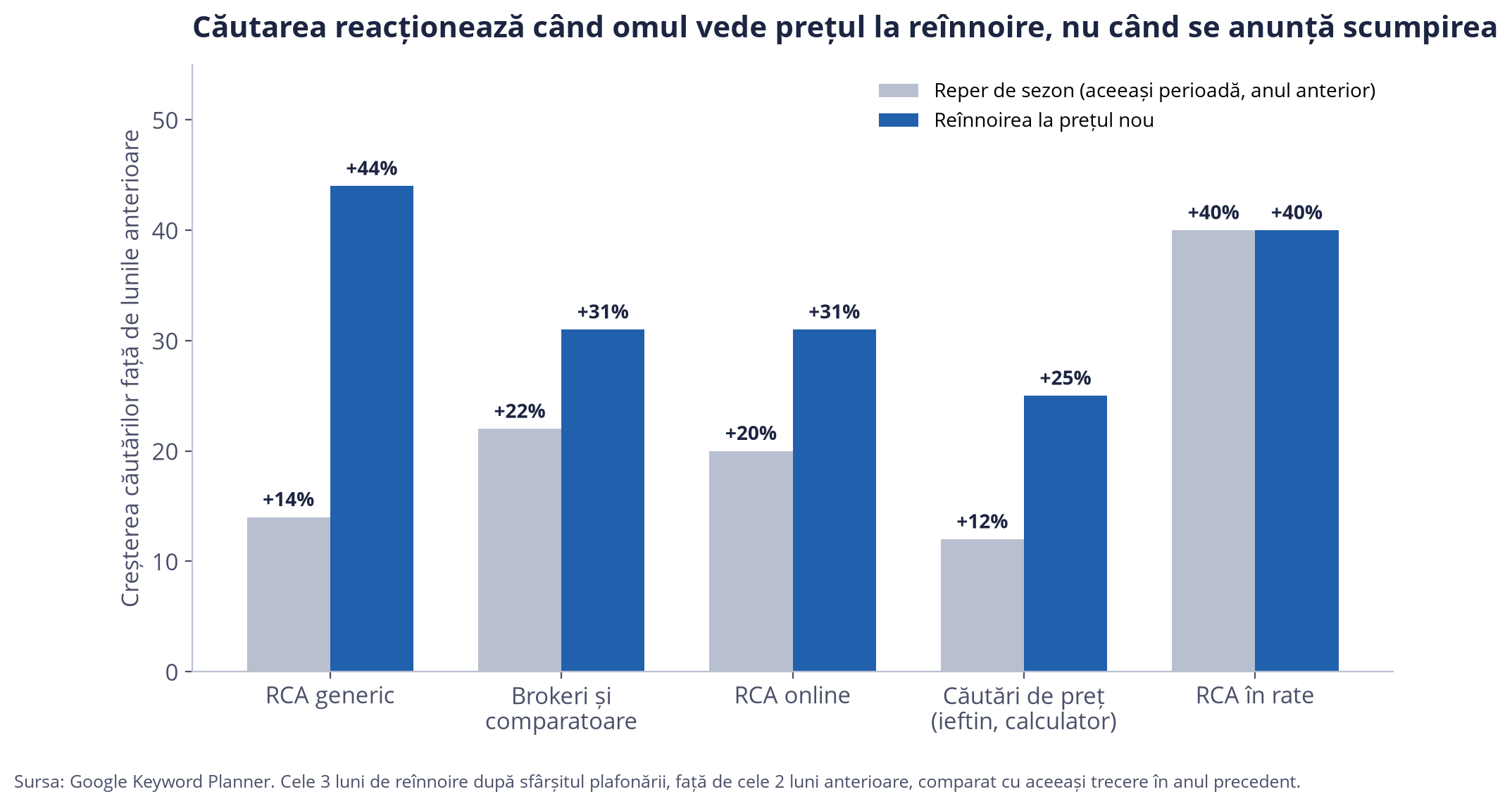
- Generic RCA: +44%, versus +14% seasonal;
- brokers and comparison sites: +31%, versus +22%;
- Online RCA: +31%, versus +20%;
- price searches: +25%, versus +12%.
The differences are roughly 9–30 percentage points above the seasonal benchmark, depending on the micro-niche. In the same episode, policy-check searches rose from about 139,000 to 165,000 a month (+18%), then held at roughly 155,000–173,000. The practical takeaway for an intermediary: it's worth planning budget around the periods when renewal intent appears, not just around the news calendar of price rises. These are search demand trends, not results from sales campaigns.
Where demand moved over four years
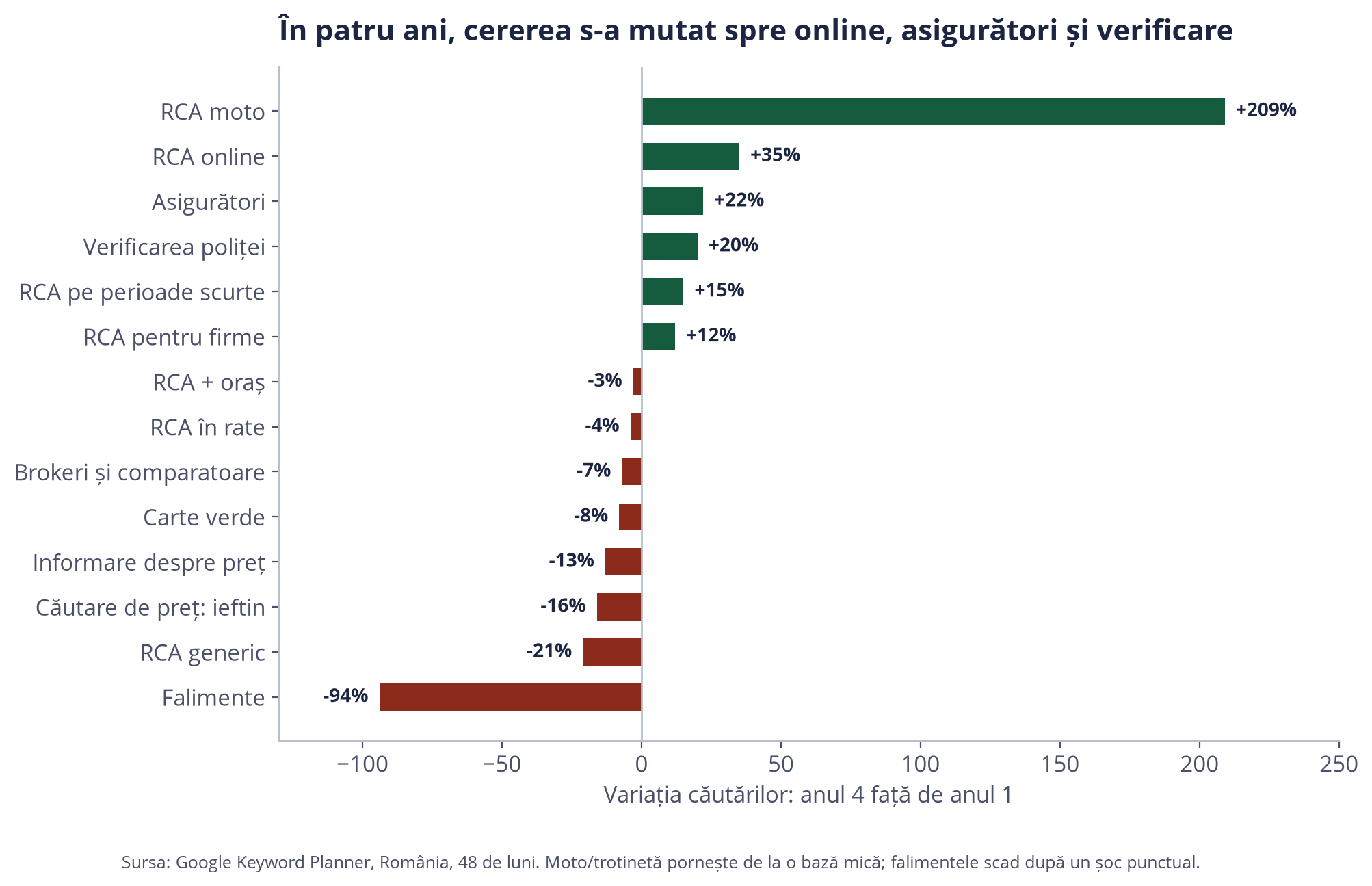
- growing: online RCA (+35%), insurer name searches (+22%), policy checks (+20%), short-term RCA (+15%), RCA for companies (+12%);
- declining: generic RCA (−21%), price and "cheap" searches (−16%), brokers and comparison sites searched by name (−7%).
Over the period analysed, some generic phrasings lost volume, while searches including "online" or an insurer's name grew. For intermediaries, this suggests tracking generic, brand and specific-need searches separately – instalments, short terms, companies or checks – without assuming every rise in volume means more policies sold.
Micro-niches born from legislation, and news spikes
- Regulatory changes can quickly create demand for information. When RCA became compulsory for certain light vehicles meeting the legal criteria, including some e-scooters, searches for "e-scooter insurance" jumped from about 175 to 2,400 in a single month. The motorbike, scooter and e-scooter micro-niche is now about three times bigger than four years ago (+209%), with an ad competition index of 31/100. More searches don't automatically mean more policies issued.
- Not every spike is demand. A public debate about the new bonus-malus system took "bonus malus" searches from about 1,300 to 18,100 in a month – a news spike, not a buying one. Budget spent on spikes like this brings the curious, not customers.
What it means for an insurance intermediary
- The policy-check opportunity: ~161,000 searches a month, with a competition index of 10/100 in Google Keyword Planner – the lowest of the 12 purchase and verification micro-niches. Searches also rise during renewal periods, but include a lot of navigation and information-seeking; how close they are to purchase remains a hypothesis to test.
- Renewal can matter more than the announcement date: in the episode analysed, the bigger reactions in purchase searches appeared when consumers reached the new price, not right after the change was announced.
- A price rise can shift interest between micro-niches: in the gradual price-rise episode, searches for RCA in instalments rose above the seasonal benchmark; during renewals, broker and online searches rose too. These are shifts in interest, not proof of sales won.
- Explicit city searches are few: the "RCA + city" micro-niche has under 1,000 searches/month nationally; on its own, that doesn't measure all local demand.
- Regulation opens up search topics: monitoring legislative changes can help spot new needs quickly; commercial potential and actual competition need testing, not just inferring from search volume.
These are exactly the kinds of signals we use in marketing for insurance brokers and intermediaries, so budget follows the real moment of decision.
Conclusions
In the episodes analysed, RCA search demand didn't always follow the news. Some of the clearest rises in commercially valuable searches came when people actually reached renewal and the new price. Meanwhile, searches for online, brokers or instalments moved differently from generic terms, and purely informational spikes shouldn't be confused with buying demand.
The research finding worth testing: the policy-check micro-niche has about 161,000 monthly searches and a Google Ads competition index of 10/100 – the lowest ad pressure of the 12 purchase and verification micro-niches studied. Not all these searches are purely about RCA, and not all have purchase intent. We haven't tested the commercial conversions of these terms here. For an intermediary, the analysis's value is in making a better-informed choice of which periods and intents are worth experimenting with in campaigns.






 © 2026 Digital Craft® Agency - All rights reserved.