


In short
- A single villa worth over €600,000, promoted through Meta Ads within roughly 1.5 km of the property.
- Multilingual ads instead of one campaign per language: Romanian, English, Arabic and Turkish, with a single budget and a combined audience.
- In five weeks: 649 visits to the property page and 12 direct enquiries (10 calls, 2 forms).
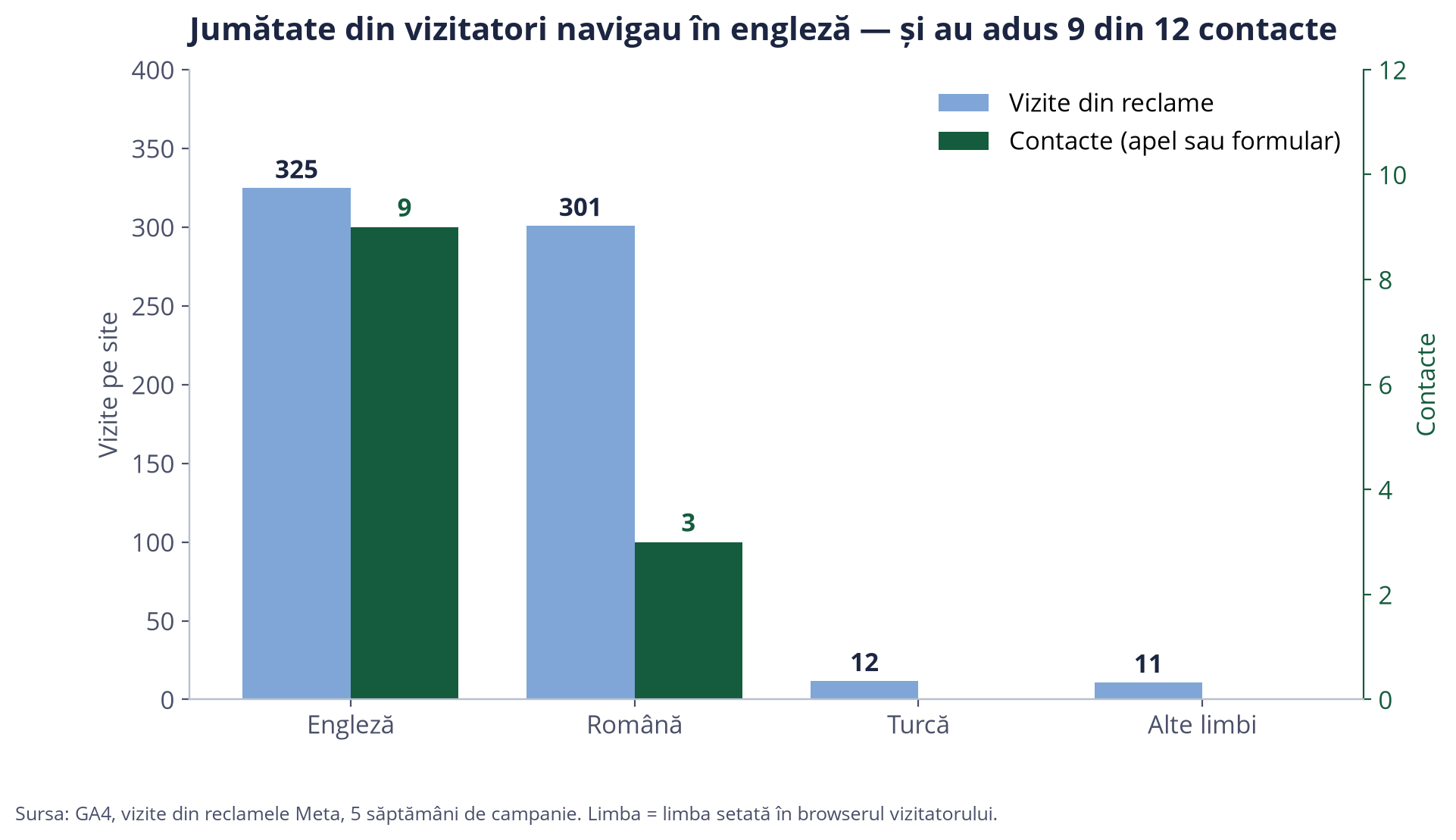
- Language mattered: visitors with an English-language browser brought 9 of the 12 enquiries.
The context: a high-end property, a narrow and multilingual audience
Promoting a villa worth over €600,000 has little in common with promoting a residential development. You're not after hundreds of forms, but enquiries from people who might be interested in a very specific property. In this project, the challenge was amplified by the geographic restriction set at the client's request: in the campaign's focused phase, the promotion area was narrowed to roughly 1.5 km around the property.
Here, the property was in a residential area on the edge of a capital city, with a large international community built around the local international schools. That changed the rules:
- the right buyer wasn't necessarily Romanian – they might speak English, Arabic or Turkish;
- messaging available only in Romanian risked being less relevant to part of the area's international audience;
- the local audience was already small – split by language, it would have become too small for Meta's algorithm to learn;
- location was decisive in building the campaign: the client asked for promotion to be concentrated in the immediate vicinity of the property.
Why not one campaign per language
The classic approach would have been one campaign per language. For a premium property with a narrow local audience, that would have meant small budgets, slow algorithm learning and a fragmented audience.
We chose Meta's multilingual ad format: within the same ad you can set a default language and translated versions of the text, headline and description, using the same images. "One ad in four languages" describes the creative mechanism here, not the total number of ads in the campaign. The platform may pick a language version based on the user's settings and signals; we don't assume a visitor's browser language automatically confirms which ad version they saw.
- a single budget – no extra cost for each language;
- no deliberate splitting of the audience into language campaigns, so optimisation works on a combined audience;
- the option to present the offer in several languages within the same ad template, depending on how the platform delivers it.
How we built the ads
The campaign was built to be multilingual from day one. Six ads ran, not just one; each used the same language-variation mechanism, and the languages in the core messaging were Romanian, English, Arabic and, later, Turkish:
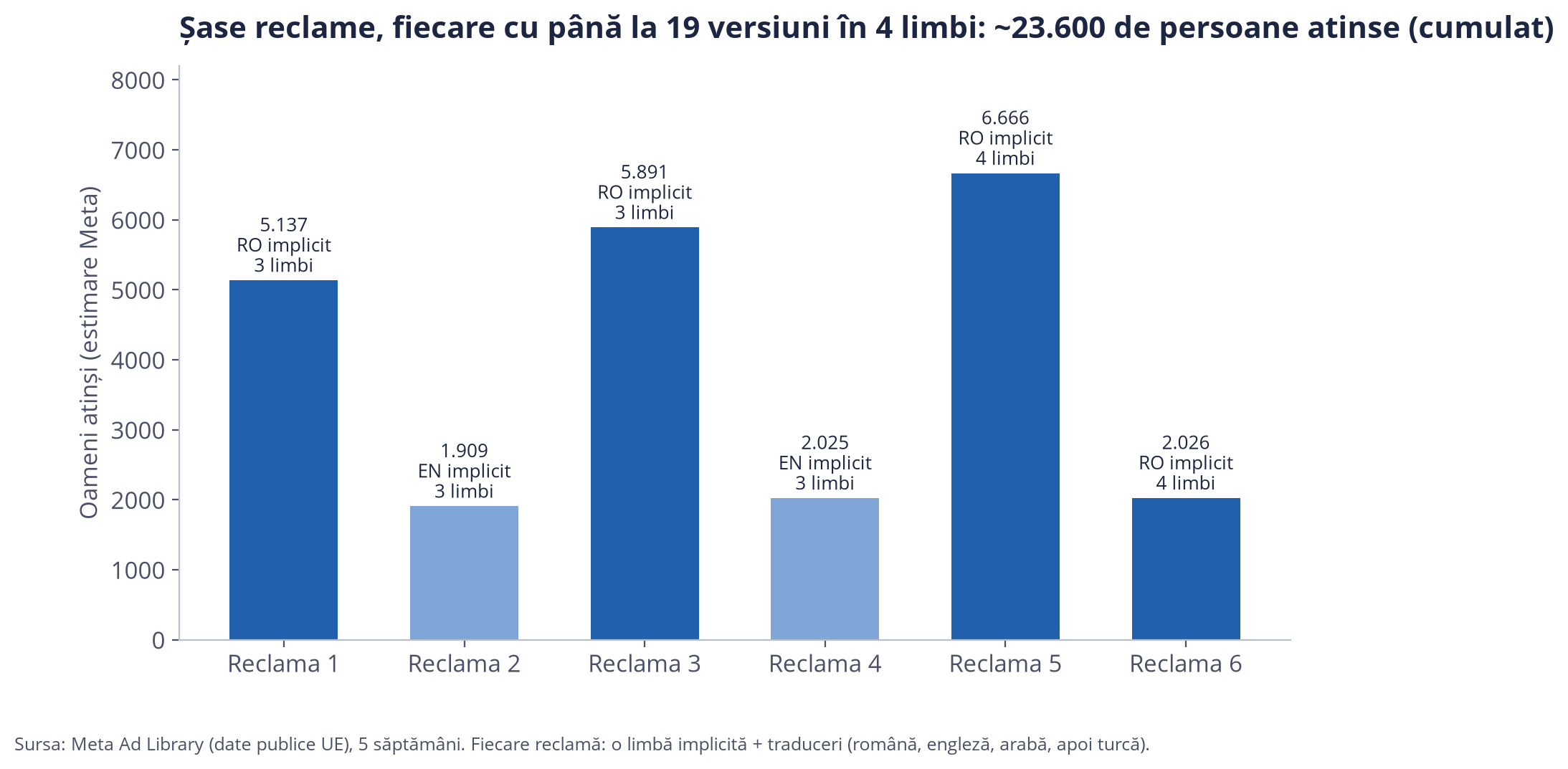
- 6 ads, with up to 19 language variants configured for each; the study follows the four languages relevant to the strategy described;
- Romanian, English and Arabic from the start, with Turkish added in the final phase, when targeting was narrowed to the property's exact area;
- pairs of ads running in parallel, one with Romanian as the default language and one with English, to test which base language reached more people;
- a single destination: the property page, with phone and form, no intermediate steps;
- separate tracking for visits, calls and forms, so each enquiry shows up separately.
Targeting: hyper-local
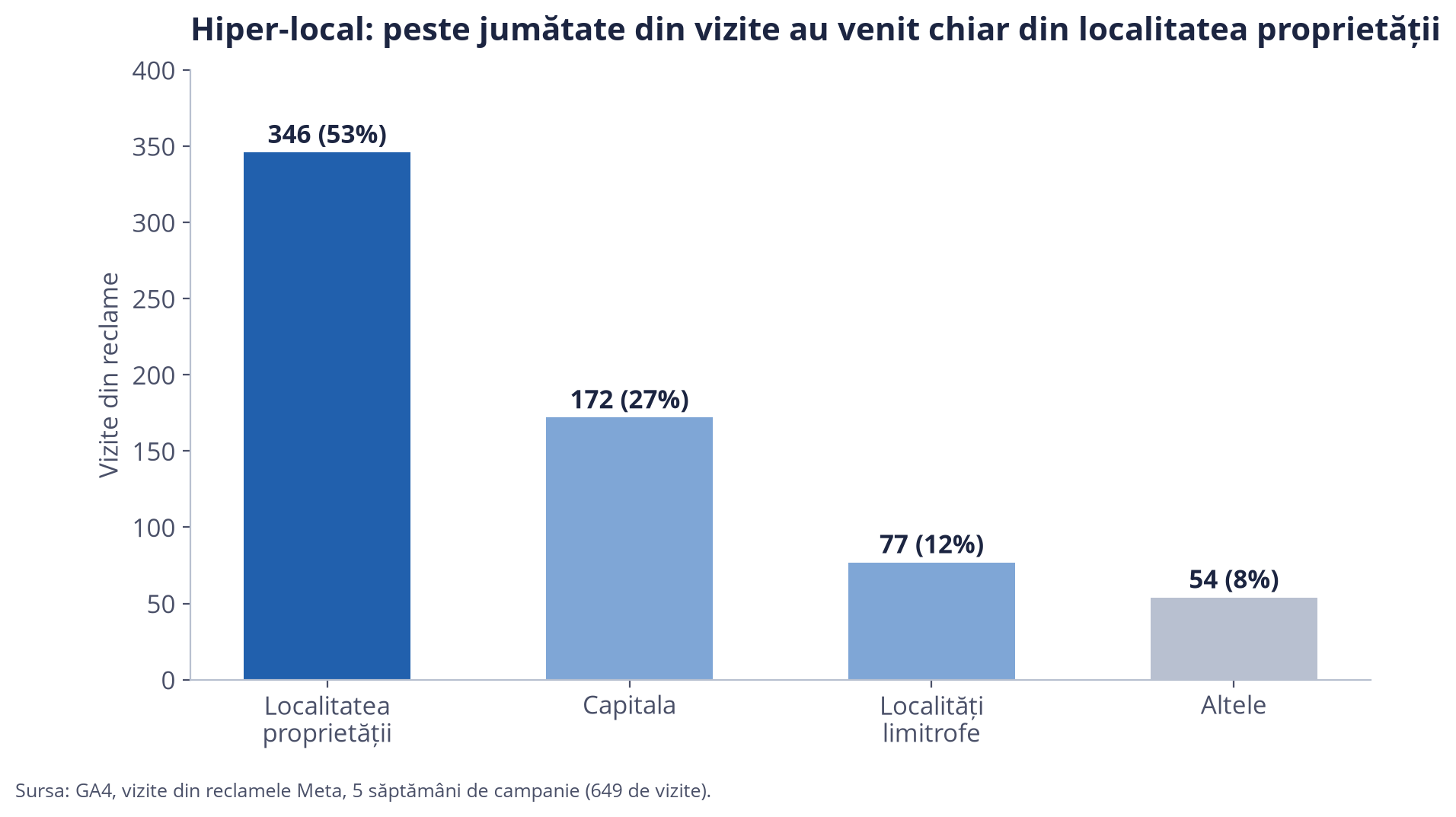
The ads initially targeted the property's town, then, at the client's request, the area was narrowed to roughly 1.5 km around the villa. Across the whole campaign's data, 53% of visits came from the property's own town, another 12% from neighbouring towns, and only about 12 visits from abroad. These figures describe where visits came from over the whole campaign, not just the final targeting phase.
In the audience reached, 62% of the people reported were aged 35–54, a feature of how the campaign was delivered, which we don't confuse with validation of purchase intent.
The results
For a single property listed at over 600.000 €, promoted in a very small area with a final focus of roughly 1.5 km, the campaign recorded the following measurable results in five weeks:
| Metric | Result |
|---|---|
| People reached (cumulative across ads) | ~23.600 |
| Visits to the property page | 649 |
| Visits from the property's town | 346 (53%) |
| Direct enquiries | 12 (10 calls, 2 forms) |
| Visit → enquiry rate | ~1.9% (one enquiry per ~54 visits) |
- 649 visits from an aggregate exposure of ~23,600 people reached, as reported per ad; since reach is cumulative across ads, we don't treat the ratio as a visit rate for unique people;
- one measured enquiry roughly every 3 days (12 enquiries in 5 weeks), for a single premium property;
- visitors from the property's town spent on average about 2.5 minutes on the page.
It's the kind of result we aim for in campaigns for developers and real estate agencies: not volume, but the right enquiries for the right property.
What we learned about the audience: language matters
The most valuable insight came from the visitor profile. Half of those who reached the page were browsing in English – and brought 9 of the 12 enquiries:
- visitors with an English browser: 325 visits, 9 enquiries;
- visitors with a Romanian browser: 301 visits, 3 enquiries;
- visitors with a Turkish or other-language browser: 23 visits.
The data supports the decision not to limit messaging to Romanian: visitors with an English-language browser generated 9 of the 12 enquiries. Browser language doesn't prove nationality, the language of the ad actually shown, or what a Romanian-only campaign would have achieved. It does show that the audience that responded to the promotion had different language preferences, a useful signal in an area with international communities.
Conclusion
In premium real estate, message language and geography can matter as much as image selection. For this villa worth over €600,000, we used a multilingual template applied across six ads, without artificially splitting the campaign into four separate language audiences. In five weeks, we got 649 visits and 12 enquiries, in a promotion geographically focused to within roughly 1.5 km of the property.
The result doesn't prove a completed sale, nor measured superiority over a single-language campaign. It does show that a localised setup, built for a very specific audience, can produce measurable enquiries even under extremely restrictive targeting.




 © 2026 Digital Craft® Agency - All rights reserved.